


 You’re invited to get up close with some of the more familiar creatures found in our ocean.
Our touch tank pool allows you to gently touch marine animals such as sea stars, sea urchins, whelks, horseshoe crabs, and hermit crabs. These animals live in a variety of habitats and have developed many ways to survive the waves and predators. Volunteers are on hand to assist and teach you about these incredible animals.
Did you know, when a sea urchin “hugs” your finger if you gently touch its spines, it’s actually checking you out: Are you food or predator? If you’re neither, the animal will just gradually release you.

 Join scientists who are investigating the boundary between our Solar System and the rest of our galaxy in IBEX: Search for the Edge of the Solar System.
Designed for visitors with an appreciation for the challenges of space science and a desire to learn more about science research, the show follows the creation of NASA’s Interstellar Boundary Explorer (IBEX). Audiences will get an in-depth look at the mission and how IBEX is collecting high-speed atoms to create a map of our Solar System’s boundary.
Narrated by two inquisitive teenagers, audiences will hear from the scientists and engineers that developed the IBEX mission and created the spacecraft, and get the latest updates on the mission’s discoveries.
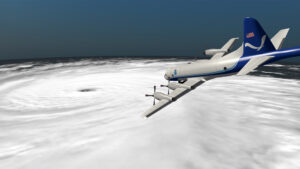

Learn how to prepare your home and family for storms ahead of hurricane season by building an emergency preparedness kit. This lesson is followed by an exciting virtual reality mobile classroom experience: flying inside Hurricane Maria. Strap on a pair of Oculus Quest virtual reality goggles and become immersed in this unique environment.
The Science in 3D program will feature Hurricane Maria on Tuesday at 11:00 pm through Memorial Day.
Join scientists who are investigating the boundary between our Solar System and the rest of our galaxy in IBEX: Search for the Edge of the Solar System.
Designed for visitors with an appreciation for the challenges of space science and a desire to learn more about science research, the show follows the creation of NASA’s Interstellar Boundary Explorer (IBEX). Audiences will get an in-depth look at the mission and how IBEX is collecting high-speed atoms to create a map of our Solar System’s boundary.
Narrated by two inquisitive teenagers, audiences will hear from the scientists and engineers that developed the IBEX mission and created the spacecraft, and get the latest updates on the mission’s discoveries.
You’re invited to get up close with some of the more familiar creatures found in our ocean.
Our touch tank pool allows you to gently touch marine animals such as sea stars, sea urchins, whelks, horseshoe crabs, and hermit crabs. These animals live in a variety of habitats and have developed many ways to survive the waves and predators. Volunteers are on hand to assist and teach you about these incredible animals.
Did you know, when a sea urchin “hugs” your finger if you gently touch its spines, it’s actually checking you out: Are you food or predator? If you’re neither, the animal will just gradually release you.
Join scientists who are investigating the boundary between our Solar System and the rest of our galaxy in IBEX: Search for the Edge of the Solar System.
Designed for visitors with an appreciation for the challenges of space science and a desire to learn more about science research, the show follows the creation of NASA’s Interstellar Boundary Explorer (IBEX). Audiences will get an in-depth look at the mission and how IBEX is collecting high-speed atoms to create a map of our Solar System’s boundary.
Narrated by two inquisitive teenagers, audiences will hear from the scientists and engineers that developed the IBEX mission and created the spacecraft, and get the latest updates on the mission’s discoveries.


Come explore gorgeous views of the cosmos like never before in our hour-long special feature, the History of the Telescope from Galileo to Webb.
The revolutionary James Webb Space Telescope (JWST) has given us extraordinary images of space and allowed us to learn more about our universe, from the earliest galaxies to the potential of life on other planets.
This show will take you on a journey through space and time, the evolution of telescope design, and highlights of the JWST’s unique features such as its infrared capabilities and its huge sunshield. You will also learn about the exciting scientific discoveries and breakthroughs that have followed the JWST’s launch in 2021.
What’s the difference between a land turtle and a sea turtle? Why are box turtles called box turtles? We will answer this question and more in this fun, interactive program. Learn about the anatomy, diet, and habits of land and sea turtles, the difference between them, and some fun facts about our favorite reptiles. A fun turtle themed craft is included.
Join us each open day at 11:00 am for family programs designed by Jamie Justice, the Education Manager for the Museum of Coastal Carolina and Ingram Planetarium, who oversees all family programs. Justice received her Bachelor of Science in Marine Biology from Bowling Green State University and her Master of Science in Environmental Science with concentrations in Marine and Coastal Education and Coastal Management from the University of North Carolina Wilmington.
Join scientists who are investigating the boundary between our Solar System and the rest of our galaxy in IBEX: Search for the Edge of the Solar System.
Designed for visitors with an appreciation for the challenges of space science and a desire to learn more about science research, the show follows the creation of NASA’s Interstellar Boundary Explorer (IBEX). Audiences will get an in-depth look at the mission and how IBEX is collecting high-speed atoms to create a map of our Solar System’s boundary.
Narrated by two inquisitive teenagers, audiences will hear from the scientists and engineers that developed the IBEX mission and created the spacecraft, and get the latest updates on the mission’s discoveries.

This is a live star show. The presenter will display the night sky on the planetarium’s dome ceiling and take you on a tour, pointing out the stars, planets, and constellations that are visible in our area. Later, as you are walking along the beach on a clear night, you will be able to recognize by name the celestial sights you see.