


Judy Sobota will give you an exclusive ‘behind the scenes’ look at our aquariums, facility operations, and Touch Tank animals. The tour will include the museum’s animal holding tank facilities that are normally closed to the public. Learn what it takes to keep our animals healthy and happy, discover the unique features of the variety of fish in our tanks, and see first hand how the aquariums are managed and operated. This program is part of our involvement with the annual NCSciFest events taking place around the state from April 1-30.
Judy was our past Volunteer Coordinator and is presently a volunteer trainer for Touch Tank responsibilities. She is an expert in many facets of the operation of our Touch Tank and aquariums as well as marine animal care. She is happy to share her knowledge about the many species of animals in the museum.

The vastness of our planet’s oceans guards unimaginable secrets. One of its most precious is Kaluoka’hina, the enchanted reef whose magic protects it against humans finding it. Kaluoka’hina’s colorful inhabitants have thus always lived in peace… until the volcano erupts and the spell is broken. Now it’s up to the young sawfish Jake and his paranoid pal Shorty to restore the magic of Kaluoka’hina. Their only lead: the ancient legend that tells of touching the moon. But how is a fish supposed to touch the moon? This is just one of the intriguing puzzles that Jake and Shorty have to solve on their most exciting adventure ever: the quest to save their beloved reef. A star show follows the movie.

This live-action full dome program puts you on the deck of the voyaging canoe Hōkūleʻa as you explore traditional Polynesian navigation. Learn how to read the stars and interpret the winds and waves to navigate without modern instruments. The film tells the story of the Polynesian Voyaging Society and the recovery of the nearly lost art and science of traditional, non-instrument navigation in Hawaii. This film was produced in Hawaii by Bishop Museum and 1001 Stories in collaboration with the Polynesian Voyaging Society.

Explore the relationship between the Earth, Moon, and Sun with the help of Coyote, an amusing character adapted from Native American oral traditions. This fast-paced family show investigates our home planet and how it interacts with our most familiar neighbors. Learn about lunar phases, eclipses and other phenomena we see in our skies to better understand how the Earth, Moon, and Sun work together as a system. Native American stories are used throughout the show to help explain various concepts. The movie is followed by a star show.
Funding for this film was provided by The Town of Sunset Beach through its Accommodation Taxes.
 Join Neil deGrasse Tyson on a journey exploring the life of a photon. Start from its creation in the belly of a star, travel across the galaxy and go all the way into the eye of a young stargazing girl. You will learn the structures of the eye and its functions while taking a ride on the optic nerve. Discover how the eye works and how technology has enabled us to restore vision and prevent a variety of diseases that affect sight. A star show follows the movie.

Ever wonder “what’s up” in the night sky? Explore the planets, constellations, and other celestial events happening in the sky tonight. This live program focuses on what you can see if you stepped outside and looked up to the heavens. Is there a meteor shower? Can you see the International Space Station? Find out how to identify these objects. This program will also comment on the latest breaking news in astronomy.
 Join us in a sensory experience unlike any other as LIVE lighting and laser effects accompany classic hits heard through the area’s best sound system.
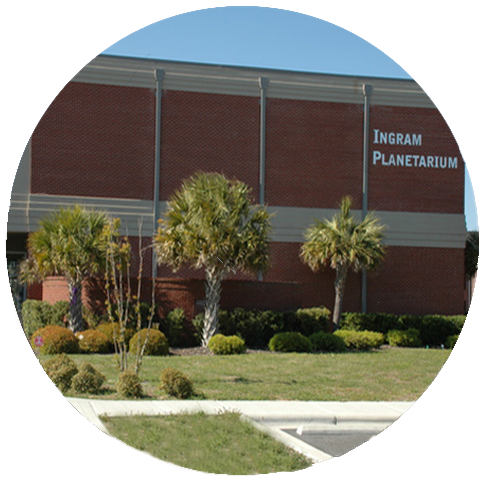 Come explore the many magnificent creatures in our night sky constellations.
Join us in a sensory experience unlike any other as LIVE lighting and laser effects accompany classic hits heard through the area’s best sound system.
 Brett Riggs discusses Operation Paperclip — the code name under which U.S. intelligence and military services extricated scientists from Germany during and after the final stages of World War II.
As World War II wound down, American and British teams scoured occupied Germany for as much military, scientific, and technological development research as they could uncover. Covert groups began confiscating war-related documents and materials and interrogating scientists. Finally, a list of scientists and engineers that had been put to work for the Third Reich was discovered. Roughly 1,600 German scientists and their families were brought to the United States to work on America’s behalf during the Cold War. The goal was to harness German intellectual resources to help develop superior American technology and weapons against the Soviet Union.
Brett Riggs is a native of Southeastern North Carolina, lives in Shallotte. He has a bachelor’s degree in history and a master’s degree in library science. His historical specialty is the Colonial era and the early American republic.